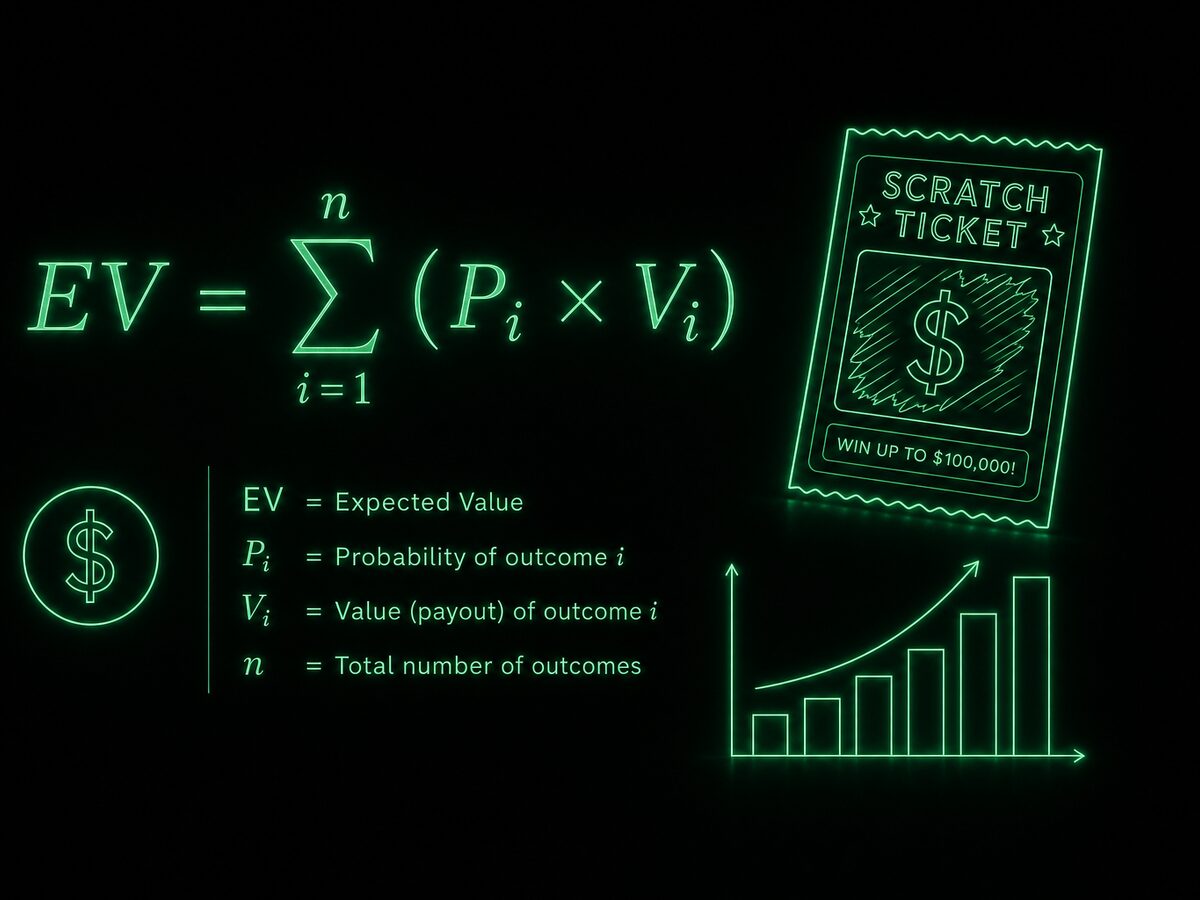
"Expected value" sounds like a statistics-class headache, but it's actually the single most useful idea in scratch-off play. Strip away the jargon and it answers one question: for every dollar you put in, how much should you expect to get back?
Expected value (EV) is just the sum of every possible prize multiplied by its probability:
[ EV = \sum_{i=1}^{n} (P_i \times V_i) ]
Where (P_i) is the probability of each outcome and (V_i) is its value. If a $5 ticket has an expected value of $3.50, that means on average you get $3.50 of value back for every $5 you spend. The other $1.50 is the house edge.
Here's the part most players miss: a scratch game's EV isn't fixed. It's printed with a certain pool of prizes, but as people buy tickets and claim winners, the prizes that remain shift the math. A game can launch with decent value and slowly bleed out as its top prizes get claimed—while you're still paying the same price at the counter.
That's why we recompute EV daily from the official remaining-prize counts. A ticket's "Expected Value" today can be very different from the day it launched.
No scratch-off has an EV above its price—if it did, the lottery would lose money. The realistic range is roughly $0.60 to $0.85 back per dollar, depending on the state and game. Your goal isn't to "beat" the lottery; it's to play the games closest to the top of that range and avoid the ones near the bottom.
Expected value won't make you a winner. But it will keep you from overpaying for games that have already given away their best prizes.
See today's best games →