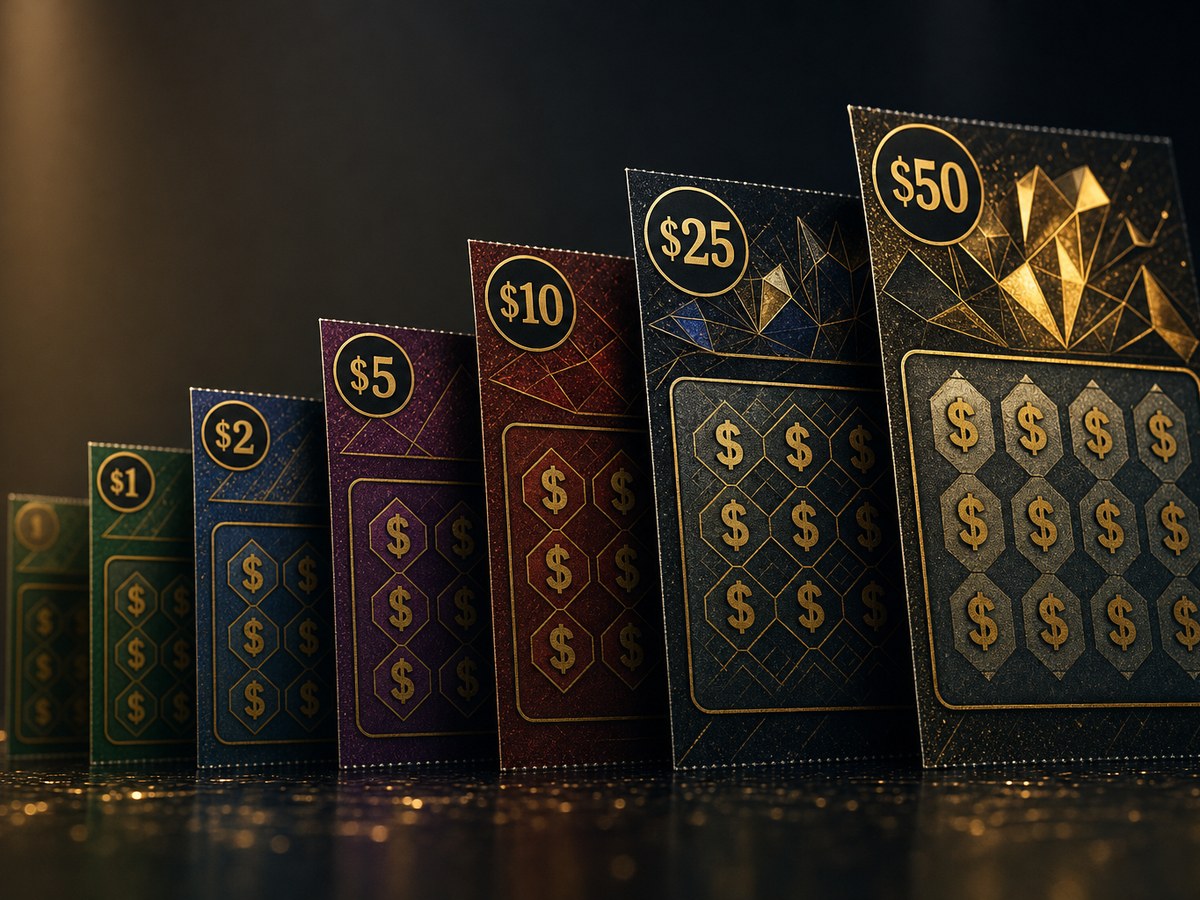
Generally, yes—higher-priced scratch-offs have better overall odds and return a higher percentage of your money than cheap tickets. A $1 ticket returns roughly 50–60 cents per dollar, while a $20 ticket returns closer to 75–82 cents. But "better odds" comes with three catches most players miss—and price alone still isn't enough to tell you which ticket to actually buy.
State lotteries deliberately design higher-priced games with better odds to justify the cost. The pattern is consistent across states:
A $1 ticket eats about 45–48 cents of every dollar; a $20+ ticket eats only about 20–25 cents. On a pure per-dollar basis, expensive tickets are the better deal. But that's not the whole story.
A $20 ticket with "1 in 3" overall odds sounds like you win a third of the time. In reality, most of those "wins" pay back less than—or exactly—what you spent. Your odds of winning more than you paid are closer to 1 in 6 or 1 in 7. Better odds mostly means you break even more often, not that you profit more often.
A better payout rate is a percentage. The dollar amount still scales with price. A $1 ticket loses about 48 cents on average; a $50 ticket loses about 20 cents per dollar—but that's $10 gone on a single ticket. Higher-priced tickets are the smarter mathematical choice only if the price genuinely fits your budget.
This is the one almost every guide gets wrong. The odds and payout rates above are launch-day averages. They don't tell you what's left in the game right now. Two $20 games can advertise identical "1 in 3.5" odds but have completely different real value today—because one still has all its top prizes and the other has been picked clean.
The question that actually matters isn't "does this ticket cost more?" It's: does this specific game still have its top prizes remaining, and how many, relative to the tickets still in circulation? A $20 game with its top prizes gone can be a worse buy than a $5 game that's barely been touched.
Start with price tier—higher-priced games ($10–$30) generally offer better odds if the price fits your budget. Then check current expected value, not printed odds. Compare games at the same price point. And match it to a budget you're comfortable with.
The problem is that doing this by hand means digging through daily-updated lottery data for every active game. That's what we handle for you: we calculate the real expected value across every price tier every day and rank them, so you get the price-tier advantage and the current-data reality check without any math.
See today's best games →