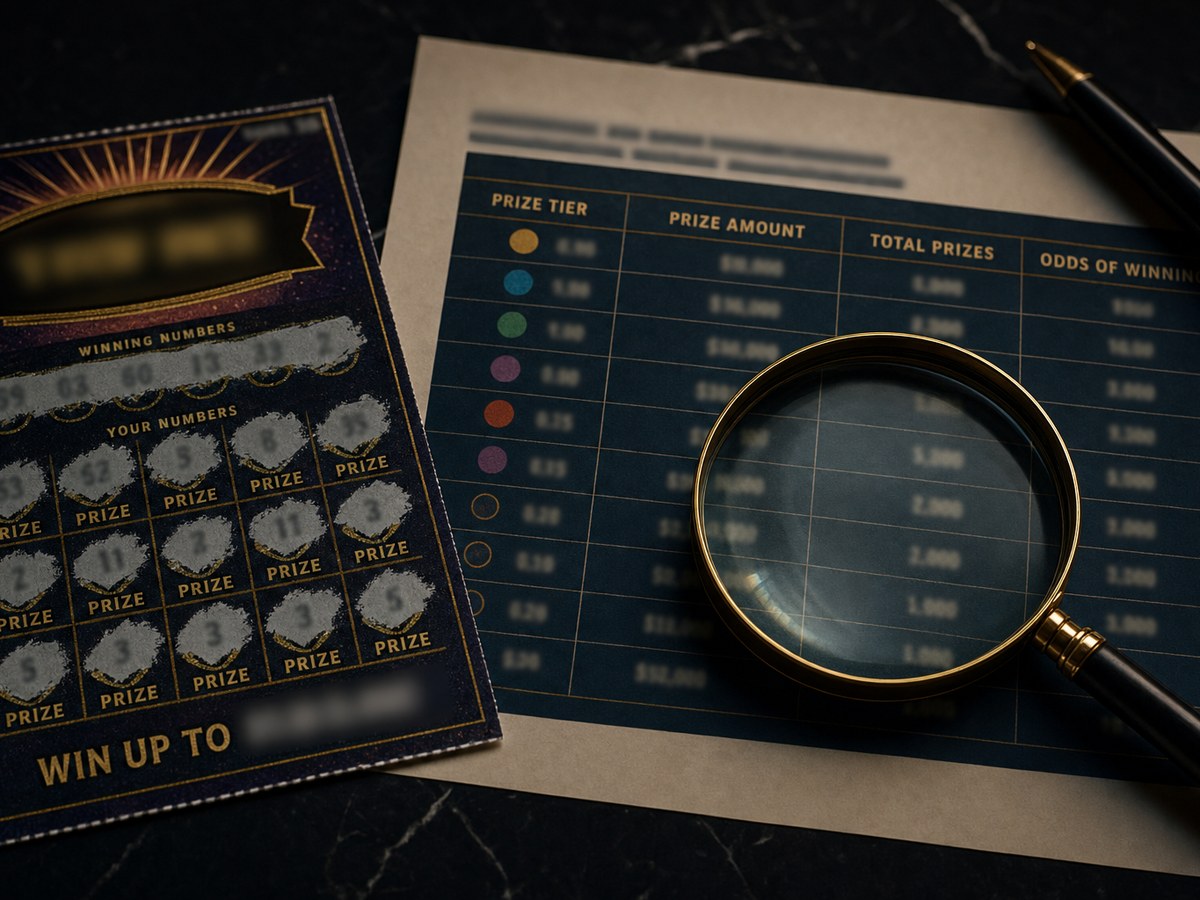
Every state lottery publishes a "prizes remaining" report—a live list of how many prizes at each level are still unclaimed. If you know how to read it, you can tell which games are actually worth buying and which have been picked clean, no matter what the printed odds say. Here's how.
When a game launches, it's printed with a fixed number of prizes at each level—say, 5 grand prizes of $1,000,000, 200 prizes of $10,000, 50,000 prizes of $500, and so on. As people buy and scratch, those prizes get claimed. States are required to report how many at each level are still unclaimed, updated regularly (usually daily). This report is the most useful—and most ignored—piece of public lottery data, because the printed odds never change but the remaining prizes tell you what's actually left right now.
1. Check the top prizes first. Look at the highest prize level. If they're all gone, the game's biggest draw is over—you literally cannot win the jackpot it's advertising. If most are still available, that's a green flag worth a closer look.
2. Compare top prizes to how far the game has sold. A prize count alone doesn't mean much—1 top prize left is great if the game just launched and terrible if it's nearly sold out. Estimate sell-through from the smaller prize levels. If a game started with 1,200,000 free-ticket prizes and 410,000 remain, roughly two-thirds of the game has sold. If top prizes are disappearing faster than tickets, value is draining out.
3. Calculate the value that's actually left. Compare the dollar value of remaining prizes to the cost of buying the remaining tickets. You don't need to be exact—the point is directional. If a game still has most of its high-value prizes and a normal number of tickets left, its value is high. If the big prizes are gone but you're still paying full price, you're funding a nearly empty pool.
4. Compare games at the same price. Never judge a game in isolation. Pull the report for two or three games at the same price point and compare. The one with more top prizes remaining relative to tickets sold is the smarter buy—even if both advertise the same overall odds.
Two $10 games, both advertising "1 in 3.6" odds. Game A launched last month with 4 of 5 top prizes remaining and most mid-tier prizes intact. Game B launched two years ago with 0 of 5 top prizes left. The printed odds say they're identical. The remaining-prizes report says Game A is a solid buy and Game B is a dead game charging full price. That difference is invisible unless you read the remaining prizes.
Reading one game's report is easy. Doing it for dozens of active games—every day, as the data changes—is genuinely tedious, which is why most players give up and grab whatever looks fun. That's exactly the work we automate: we pull every state's report daily, estimate tickets remaining, calculate real expected value for every game, and rank them. You can still read the raw data if you want. We just do the tedious part for you.
See today's best games →